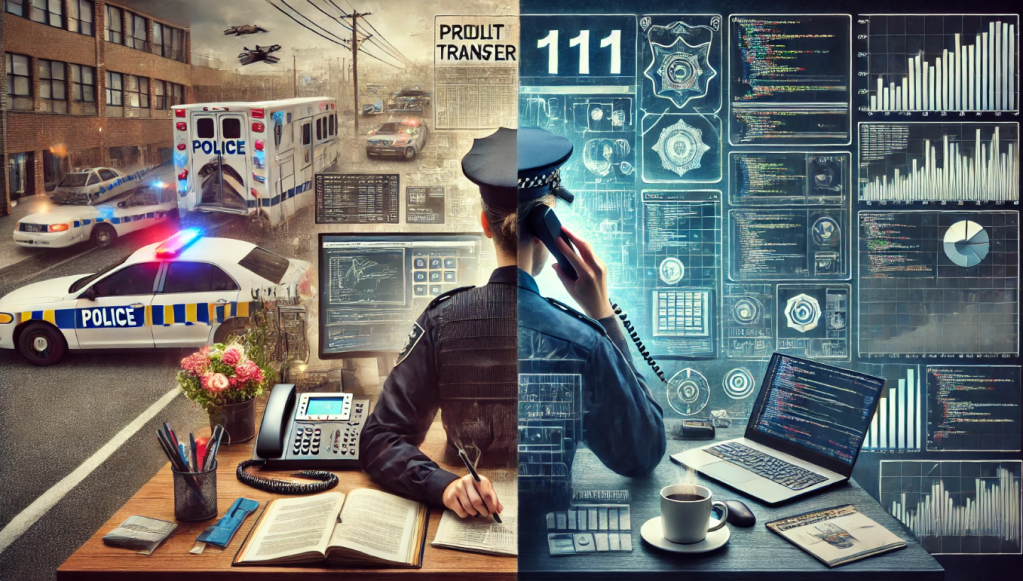
I spent about eight years in the police as a whole, including my time as a non-sworn employee working in the Police Communications Centre answering 111 calls when I was at uni. I loved it. I got a lot out of it. I may even go back some day. For now though, I am using a lot of the skills and knowledge that I gained during that time in my life on a daily basis.
I am bad at explaining how it helps me though. I am not good at interviews. Funnily enough, I am also not good at telling stories. Talking about myself is not my strengths. I can talk about systems all day long if I need to, but talking about myself is not something I am good at.
I am working on it though.
And part of working on it is listing some of the skills I have now, which I got from my time in the police, which help me out on a regular basis.
- Prioritising: in IT, depending on your team culture and manager, standards for prioritisation can vary a lot. A lot of the time, everything is “Priority 1”. But the reality is that if everything is Priority 1, nothing is actually Priority 1, and you actually have no prioritisation system – just a facade of one. In the police though, you actually have to prioritise. You can not be in two places at once, and you have to be part of the process that prioritises things properly and responds to them. Is there a risk to life or property? Does anyone have a weapon? Can you see anybody injured in the car? Are the offenders still present and about to kick off again? These types of questions dictate the response, and, when a lot of the politics involved in IT prioritisation is stripped away because you are dealing in real time with real risk, it actually gets simpler.
- Delivering a briefing: in the police, I loved delivering briefings before executing a search warrant (I loved the convoys on the way to them too). I love how comprehensive the system for this is for delivering agood briefing (GSMEAC, taken from military systems) and how it helps to make sure the most important information is conveyed in the right order. In IT, when giving a briefing about a piece of work, I like to roughly follow the same format. It is effective and it makes sure that I convey the right info. It is also great for people working on the same thing to know that there is a solid plan and some leadership in place to get done what needs to be done.
- Collecting evidence and conducting an investigation: I think this is probably the most transferable skill. It kind of sounds obvious though, doesn’t it, and can’t everyone do this? I think that the general approach is something that is helpful, though:
- Get the report: in IT – the ticket or bug. In the police, the call.
- Make the situation safe: in IT – come up with a plan to stop the bad thing from happening as soon as possible if it is still causing impacts or corrupting data. In the police, separate whoever needs to be separated. Get people away from danger.
- Collect evidence: in IT – take a look at the logs, talk to people, look at how the process should work. In the police, gather any physical evidence, take statements, download the CCTV, talk to witnesses.
- Determine a plan for handling it
- Hoping for the best, but preparing for the worst: some people might call this pesimism, but I think of it as realism. I assume that everything I work on could or will fail and try to make sure that there is something in place to handle this. I was listening to a recent Stack Overflow podcast from Pradeep Vincent, Senior Vice President and Chief Technical Architect for Oracle Cloud Infrastructure where he talked about making these assumptions at a larger scale for their cloud infrastructure. He talked about the checks and balances they have in place for dealing with these failures gracefully. A lot of stuff like disaster recovery is actually pretty gracefully handled at the bigger scale like at your cloud provider level, but you have to make sure that your code and your system can handle big and small things too. And that doesn’t mean just adding logging. In a similar vein in the police, you make a risk assessment and prepare for the unexpected. You take backup. You think about what you will do if you have to get out quickly or you have to engage someone.
- Creating good notes and documentation: in the police, I was great at using my notebook. I used it a lot more than others. Notebook entries are contemporaneous notes and are very powerful in court. They are a lot more reliable than your memory. In IT, I like to use OneNote extensively and to make good notes of conversations and of processes. In fact, I will often bring OneNote out during a Teams call and write notes while I am chatting with the other person, whether that be a business analyst, product owner, or another developer. This could be just notes about the call, but I also sometimes write the pros and cons of each choice when attempting to make a decision and people react quite well to this.
- Delivering a sitrep: when I joined a new section (a group of ~20-25 split across three main stations) the Senior Sergeant on the section told me how he wanted his briefings when he showed up on a job: 1) what has happened, 2) what is your plan, and 3) do you need anything from me? I like it. Simple and to the point. And to this day, I use the same format when letting my boss know about anything important. I almost always have a plan and really like to be able to say that and to say that nothing is needed from him and that I’m just letting him know about something.
- “Actors on” when under pressure: when I was working at the police college firstly as an Acting Sergeant and then later as a Senior Sergeant, a new system for recruit training was being rolled out. It was a good system and involved teaching recruits some skills for handling pressure in general, dialling things up a bit, seeing how people performed, and then providing a constant flow of constructive feedback. I have heard a lot of people saying that vulnerability is strength and that it is good to show it as a leader. I disagree with the framing (I agree that it can be good in the medium and longer term for somet things and can be good to help others open up). Projecting confidence though is very important when the stakes are high. People need to know that you’ve got this. Or that if you don’t, you’ve got a plan to get there. Anyway, the system had a phrase, “actors on” and I don’t remember the exact meaning. But the meaning I got from it was that, under pressure, you need to show composure: control your breathing, maintain strong body language. And smile.
- Drinking more coffee than everyone in the office
 Solution Sergeant
Leave a comment